

Building AI for Fixed Ops
AI for Fixed Ops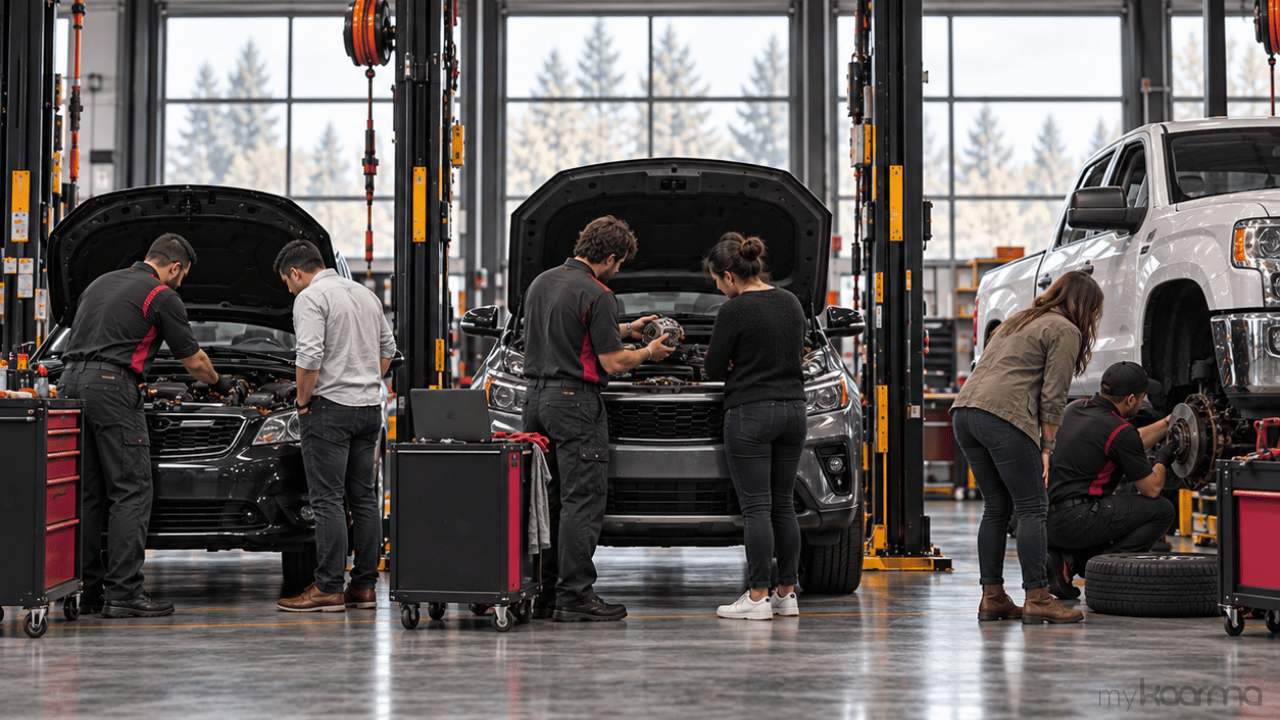
How myKaarma builds better dealership AI through fixed ops experience
Consider a returning customer calling your service lane on a busy Tuesday morning. She needs to move her 10:00 AM oil change to Thursday afternoon, keep her shuttle reservation, and talk to someone about a faint brake squeal that was noted during her last visit. On paper, it sounds like a simple administrative request. In reality, handling it requires knowing how your shop manages loaners, who owns customer follow-up, and whether Thursday afternoon has available shop capacity or just an open parking spot.
We build AI around the work dealership teams actually do. Our fixed ops experience helps us identify the information, actions, and human judgment each request requires. As a service growth platform built specifically for franchise dealerships, myKaarma designs tools that take useful action inside real workflows and know exactly when to hand off context to a team member.
Start with the work happening in the service lane
An advisor, a technician, and a BDC agent experience the exact same customer request through completely different lenses. A BDC agent needs to fill an open appointment slot quickly. An advisor needs to ensure the shop has technician capacity for diagnostic time. A technician needs accurate, detailed notes on the customer concern before the vehicle enters the bay.
When AI software treats these roles as identical, the breakdown is immediate. An arrival slot is not the same thing as repair capacity. A recorded customer concern is not a completed diagnosis. Promising a loaner vehicle without verifying shop policy creates friction at the service counter before the customer even steps out of their car.
That is why domain experience must serve as a foundational design input. We observe how service teams work, where handoffs fail, and where incomplete software causes staff to re-enter data across multiple tabs. Designing AI for fixed ops means building software that respects operational realities rather than forcing staff to clean up software mistakes.
Give AI the dealership context employees rely on
To make informed decisions, AI tools must draw on the same shared platform data your employees rely on every day. Isolated chatbots treat every customer interaction as a fresh, context-free conversation. That approach forces returning customers to repeat their vehicle details, mileage, and active service concerns.
When an AI assistant has access to historical customer and vehicle records, appointment schedules, and dealership service rules, the interaction changes completely. Connected tools can reference an open recall, recognize a deferred maintenance recommendation, and check whether a customer prefers text or phone updates. When integrating with your dealer management system (DMS) and service lane technology, the goal is contextual understanding.
Access to data is only half the equation; knowing how that data applies is what prevents operational mistakes. Fixed ops knowledge determines which record matters, what information requires confirmation, and when a request needs manager discretion before making a promise to a customer.
Turn informed conversations into supported in-app actions
Understanding a customer’s request is only useful if the system can complete the necessary action inside your existing tools. A conversation that ends with a helpful suggestion still leaves work for a staff member if the appointment is not updated in the system.
In a supported workflow, the AI takes the customer’s request, checks configured scheduling rules and shop capacity, and completes the appointment change directly in the application. As Animesh Pathak, VP of Engineering & R&D at myKaarma, explains: “Anything you can do by clicking buttons in the myKaarma application, a program should be able to do for you.”
When AI performs an in-app action, it must leave a visible, usable audit trail for your team. A proposed time and a confirmed booking are separate operational states. If an automated action cannot be completed due to a rule conflict, the system flags the issue clearly so an advisor can step in without missing a beat.
Build human judgment into the workflow
Automation should never isolate customers or force complex service decisions onto a bot. Effective AI workflows identify specific escalation triggers: when a customer asks to speak with a staff member, when diagnostic details are uncertain, or when a request requires advisor discretion.
When a handoff occurs, timing and context determine the quality of the customer experience. Routing a request before making an unsupported promise protects your dealership’s credibility. The handoff must transfer complete context: customer intent, vehicle details, completed actions, open questions, and any commitments made.
A successful handoff is measured by whether an employee receives and resolves the request, not merely whether the system attempted a transfer. When your team can read a brief summary and take over the conversation instantly, the customer experiences a single, continuous interaction.
Put fixed ops experience to work in myKaarma AI
We apply this design approach across our core solutions. Our AI voice scheduling and pre-visit intake solution, ServiceConcierge with Service Pre-Diag, handles inbound calls, captures structured customer concerns, and updates appointments using real-time availability. It works alongside Scheduler+ to apply your dealership’s specific shop rules, transportation limits, and capacity limits.
During pre-visit intake, Service Pre-Diag generates structured summaries, transcripts, and customer media that feed directly into staff views, as outlined in the Service Pre-Diag support overview. This connects smoothly with broader DMS software and service platform integration and specialized AI voice agents for dealership service scheduling.
Our collaborative development loop relies on direct dealer feedback. For example, during a working session at our Dealer Innovation Summit, the IT director at BMW Northwest built a custom ServiceCart parts-import extension to solve a specific workflow hurdle in his store. That direct collaboration helps us refine features based on how dealerships operate.
Evaluate AI with a real service request
When evaluating AI tools for your service lane, test them against both routine tasks and real-world exceptions. Bring a standard appointment booking along with a complex request involving an unresolved vehicle concern, a shuttle request, and a schedule change.
- Does the system understand specific fixed ops tasks and operational terminology?
- Does it draw on relevant platform data rather than treating every call as a blank slate?
- Can it execute supported in-app actions to complete the workflow without duplicate entry?
- Does it hand off complete context to an employee the moment human judgment is required?
Request a demo to see how myKaarma applies fixed ops experience to your dealership’s AI workflows on our service growth platform.
AI for Fixed OpsRecent
AI Readiness for Dealers and Fixed Ops
Oct 20, 2026

Premium AI Experience for Premium Brands
Oct 10, 2026