Automotive Workflow AI: The Service Lane as a Rules Engine
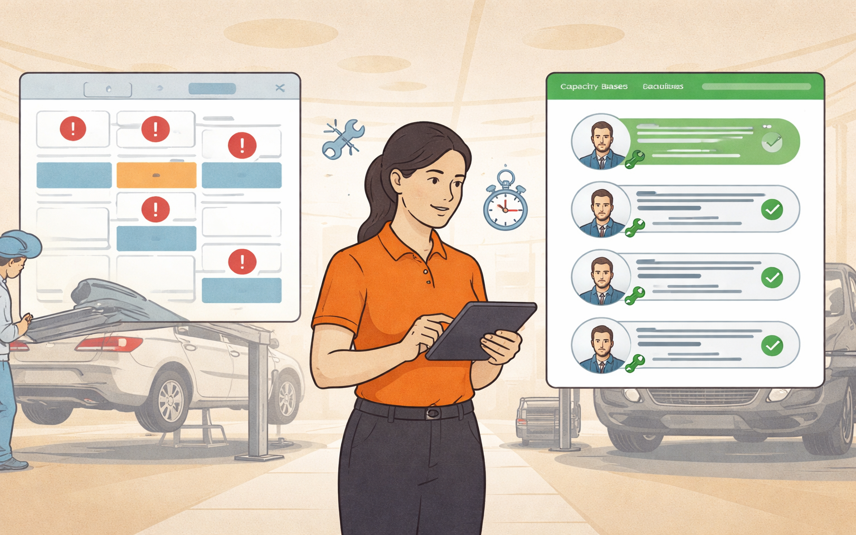
The service lane has always run on unwritten rules: who to call back first, which appointments to prioritize, how many waiters the shop can handle, and when advisors should push for drop-offs over walk-ins. These rules have lived in people’s heads—and it’s why service operations break down when the phone rings nonstop or appointment volume […]
The service lane has always run on unwritten rules: who to call back first, which appointments to prioritize, how many waiters the shop can handle, and when advisors should push for drop-offs over walk-ins. These rules have lived in people’s heads—and it’s why service operations break down when the phone rings nonstop or appointment volume spikes.
Automotive Workflow AI changes this.
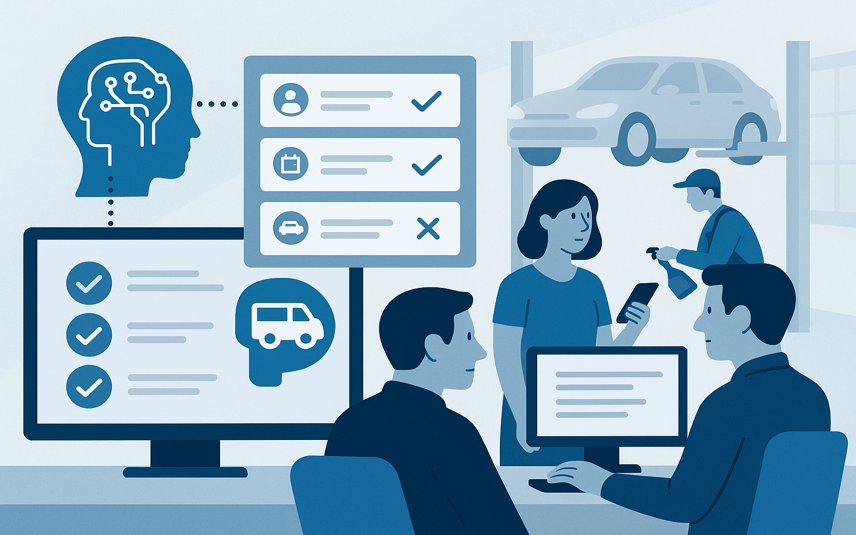
Instead of advisors manually triaging calls, availability, and capacity in real time, the service lane becomes a rules engine: a system that makes routing decisions automatically so advisors stay focused on customers—not logistics.
This is the shift behind Service Concierge + Scheduler+. Together, they turn the service lane into an automated, capacity-aware workflow that increases throughput without adding headcount.
The Problem: Advisors Are Doing the Work of a Routing System
Most service departments still rely on advisors to:
- Decide which calls to answer and which to send to the queue
- Manually juggle capacity when appointments pile up
- Steer customers into the right transportation option
- Track shop load and technician availability
- Coordinate call-backs and follow-ups
- Re-ask diagnostic questions across multiple calls
This “human rules engine” approach has three negative effects:
1. Advisors lose hours to micro-decisions
Every decision to route a call, adjust an appointment, or check capacity costs time—and the cumulative overhead is enormous.
2. Customer experience becomes inconsistent
Two different advisors may give two different answers because the rules aren’t standardized.
3. Throughput gets capped by human bandwidth
When the routing depends on humans, the shop hits a ceiling long before the technicians do.
Advisors should be helping customers.
The system should be doing the triage.
The Shift: Workflow AI Turns Rules Into Automation
Workflow AI evaluates every incoming request—call, text, appointment, callback—and applies dealership-specific logic instantly.
It becomes the “traffic controller” for the service lane:
Capacity-aware scheduling
Automatically routes customers into appointment slots that match technician capacity, skill level, and transportation availability.
Call-handling logic
Routes inbound calls based on:
- time of day
- advisor workloads
- call type (status update, appointment, recall, etc.)
- vehicle history
- urgency
- whether the RO already exists
Transportation rules
Automatically determines whether the customer receives:
- loaner
- shuttle
- pickup & delivery
- in-store drop-off
…based on availability and store preferences.
Diagnostic workflow routing
With Pre-Diag integrations, AI can gather symptoms ahead of time and route requests differently for:
- known issues
- recall-related concerns
- electrical vs. mechanical symptom categories
- high-severity complaints
The service lane stops running on manual judgment calls—and starts running on consistent, automated logic.
What This Looks Like in Practice
1. Service Concierge handles the front door
All inbound calls get triaged instantly:
- Existing RO? → Routed to the right advisor queue
- Status check? → Direct to automated status or outbound call-back
- New appointment? → Sent straight into the scheduling workflow
- Transportation request? → Matched to capacity rules
- Recall or campaign question? → Routed to the correct path automatically
No advisor needs to answer the phone just to redirect the customer.
2. Scheduler+ enforces capacity rules
Every appointment—no matter the source—follows the same automated logic:
- Technician availability
- Required skill category
- Estimated RO hours
- Loaner/shuttle inventory
- Shop throughput targets
- Existing next-day backlog
This stops the “stacked mornings / empty afternoons” problem and preserves technician efficiency.
The Impact: A Service Lane That Scales Without More Staff
1. Advisors gain hours back every day
When routing and triage disappear, advisors spend more time:
- recommending services
- advising customers
- moving ROs
- building relationships
Not flipping between phones, calendars, and capacity charts.
2. Customers get faster, cleaner experiences
Because rules are automated:
- calls route cleanly
- appointments match shop load
- status updates reach customers without manual follow-up
- transportation is clearer and more predictable
Consistency goes up. Confusion goes down.
3. Throughput increases because the bottleneck moves
Most service departments aren’t limited by technician hours—
they’re limited by how well they route work.
Workflow AI removes that bottleneck.
4. Management gets predictable, repeatable operations
When rules drive the service lane instead of individual judgment:
- KPIs become stable
- staffing becomes manageable
- throughput becomes forecastable
- the customer experience becomes uniform
It’s a more resilient operation.
The Future: A Fully Automated Service Lane Rules Engine
Service Concierge and Scheduler+ are the first step toward a fully automated service flow:
- AI-powered symptom capture
- Fully capacity-driven appointment routing
- Real-time call deflection and categorization
- Advisor-free triage
- Automated outbound call-backs
- Predictive load balancing
- Transportation optimization
The more rules the AI handles, the more advisor time shifts back to selling, communicating, and retaining customers.
The service lane stops being reactive and becomes a forward-looking, capacity-managed system.
Conclusion
Automotive workflow AI brings structure, predictability, and scale to one of the most chaotic parts of fixed ops: the moment customers enter the system.
By turning the service lane into a rules engine—powered by Service Concierge and Scheduler+—dealerships eliminate manual triage, protect advisor bandwidth, and increase throughput without adding staff.
The future of fixed ops isn’t just digitization.
It’s automation that runs the rules for you.