AI in Fixed Ops: What’s Real Today (and What Isn’t)
For years, fixed ops leaders have heard that “AI is coming to the dealership,” but most haven’t seen it happen. The reality is that much of what is marketed as AI today is either too generic, too shallow, or too disconnected from dealership operations to make a difference. Yet the demand is real: phones never […]

For years, fixed ops leaders have heard that “AI is coming to the dealership,” but most haven’t seen it happen. The reality is that much of what is marketed as AI today is either too generic, too shallow, or too disconnected from dealership operations to make a difference. Yet the demand is real: phones never stop ringing, appointment volume spikes without warning, and customers still repeat the same concerns to three different people before an RO is written. Somewhere in that chaos, there should be value for AI.
There is. It just isn’t where most vendors are looking.
The most effective uses of AI in fixed ops right now share a common design: they remove manual work from advisors. AI doesn’t need to diagnose vehicles or make service recommendations to create ROI. It simply needs to collect information, structure it, and route it to the right place so advisors can spend more time with customers and less time doing repetitive intake and triage. This is the core value behind tools like Pre-Diag, Service Concierge, and Scheduler+.
The Work That AI Is Actually Replacing
A surprising percentage of advisor time is spent bringing order to chaos. A typical day might begin with multiple phones ringing simultaneously, and customers walking up to the counter. Then, there’s a follow-up call from yesterday, a walk-in customer wanting a shuttle, and someone demanding an appointment before noon. Their work day is a mix of decisions, callbacks, and scheduling — but rarely service advice, and almost never deep customer conversations.
AI delivers value by absorbing those distractions.
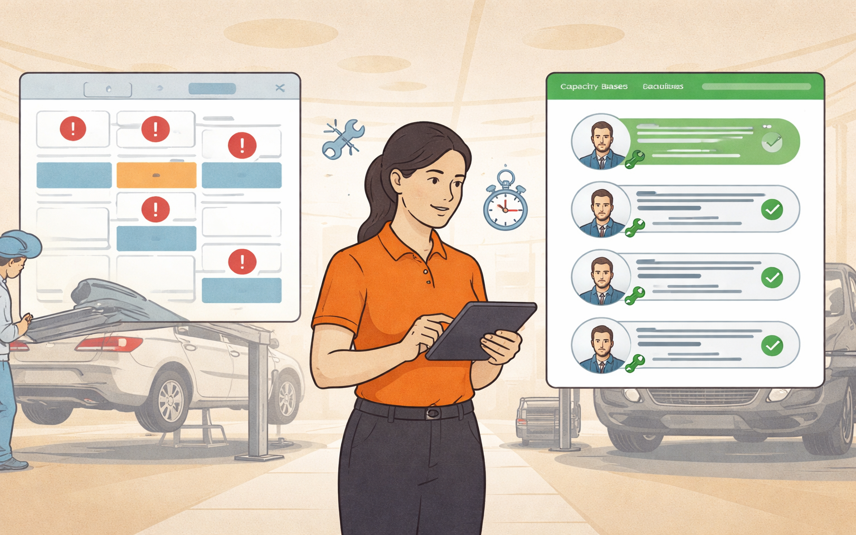
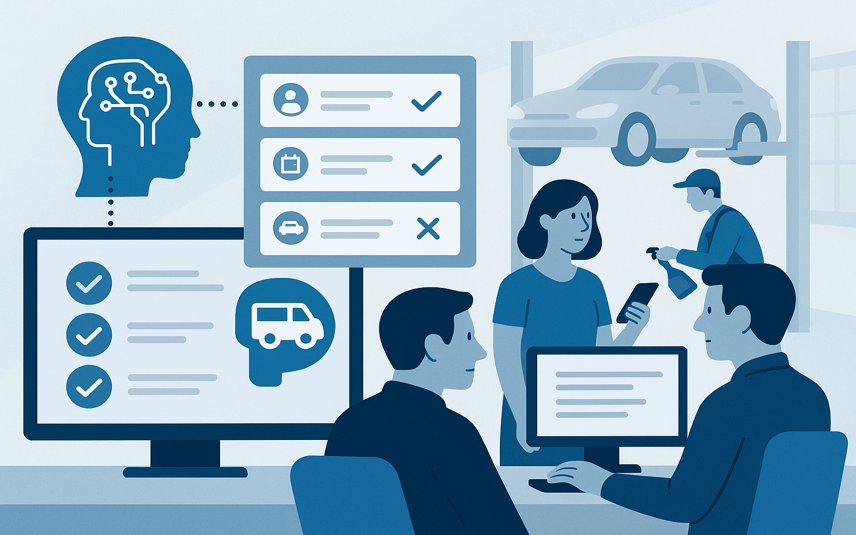
Pre-Diag automatically collects and structures symptoms so advisors don’t have to ask the same questions twice. Service Concierge routes inbound calls based on known conditions — whether a customer needs a status update, has a new concern, or simply wants to book transportation. Scheduler+ applies capacity rules so the morning no longer becomes a parking lot while the afternoon sits empty. None of these examples seems futuristic or unreasonable. They are useful precisely because they are boring. They eliminate the repetitive work that consumes hours every week.
Fewer Phone Calls, Fewer Re-Interviews, More Throughput
Every dealership that implements workflow automation comes to the same conclusion: their techs weren’t the hindrance. Their advisors were.
The bottleneck is not usually labor in the shop; it’s the continuous triage at the service counter and on the phone. When a customer has to repeat their problem two or three times because the first person didn’t write it down, everyone loses time. When the phone rings and someone picks up only to redirect the caller, that’s a minute lost with no value. Multiply that across a day, and advisors have lost hours.
AI’s role is to eliminate those delays.
A customer can report a symptom once, and the system remembers it through the workflow. Calls can be routed to the right place automatically. Transportation decisions can be made based on set rules rather than phone tag. The impact isn’t theoretical. It shows up in usable hours returned to the team. Advisors spend more time recommending services, moving ROs, and coaching customers through decisions. That work is where revenue is created.
What AI Isn’t Doing — Yet
It’s just as important to understand what AI is not doing in fixed ops today. It is not diagnosing vehicles from a text message. It is not replacing the advisor relationship. And it is not predicting failures at scale in a way that can reliably be executed in a dealership environment.
Predictive service is an OEM play right now. Advisors still need context, customers still need human communication, and technicians still need to diagnose. There is no replacement coming for that expertise. What AI does well is everything around it: gathering data, routing requests, and creating structure so humans spend less time on logistics and more time on decisions.
This is the difference between hype and value. Tools that promise to replace judgment don’t reflect reality. AI Tools that eliminate repetitive overhead are already in use.
A Shift Toward Rules, Not Guesswork
Fixed ops is evolving toward a rules engine model rather than a crystal ball. The service lane is full of logic: when to offer a shuttle, when to hold a drop-off, which technician is available, and how many appointments the shop can absorb at once. Historically, that logic has lived in people’s heads. Everyone “knows” the rules, but no one writes them down.
Now, AI can do that work.
When scheduling is capacity-aware, the shop doesn’t get crushed in the morning and idle by mid-afternoon. When transportation rules are automated, loaners don’t disappear by accident. When call handling follows logic instead of availability, customers don’t wait for answers. This isn’t glamorous. It is an operational discipline enforced by software, and it is extremely effective.
The Real ROI Pattern in Stores Using AI Today
Dealerships using workflow automation tend to see remarkably similar results:
- Advisors reclaim meaningful hours each day
- Customers get cleaner experiences with fewer touchpoints
- Throughput increases without adding headcount
- KPIs become more stable and forecastable
These outcomes come from removing overhead, not adding technology. The work doesn’t get faster because a model is smarter. It gets faster because it isn’t being repeated.
In most stores, the limiting resource is not technicians. It’s advisor bandwidth. When AI handles intake, routing, and scheduling, that constraint disappears. The work flows through the shop more smoothly, and the existing staffing suddenly feels bigger.
Where Fixed Ops AI Goes Next
The future of AI is clear. More rules will be added to the system. More decisions will become automated. And more advisor time will shift from logistics to customer communication, coaching, and sales.
The shops that benefit most won’t be the ones chasing AI fantasies or promises of autonomous repair. They’ll be the ones investing in workflow. The gains are not dramatic or cinematic. They are incremental, stable, and extremely valuable.
The future of fixed ops is not prediction or replacement.
It’s automation of the rules that already run the service lane — making them consistent, scalable, and invisible.
Conclusion
AI in fixed ops is a reality, but not in the way many imagined. The biggest wins are in eliminating repetitive work: reducing re-interviews, cutting phone load, and removing approval friction. These are the places where data is clean, patterns are strong, and decisions can be applied automatically.
Pre-Diag, Service Concierge, and Scheduler+ represent this category: tools that quietly run the service lane so advisors can focus on the customer. That is where the ROI is improving right now, and where it will continue to grow.
If you want to see the shift in action, a demo is the fastest way to understand it — because the value becomes obvious the moment the phone stops ringing and the morning rush finally feels manageable.